Wednesday, June 29, 2005

Update

Bruno

Thank you for your comments. I took a decision not to respond to strykerdad comments, his way in discussion is very irritating, but as he lately offer to help Iraqi patients, I have to reconsider my decision. I may understood him wrongly.

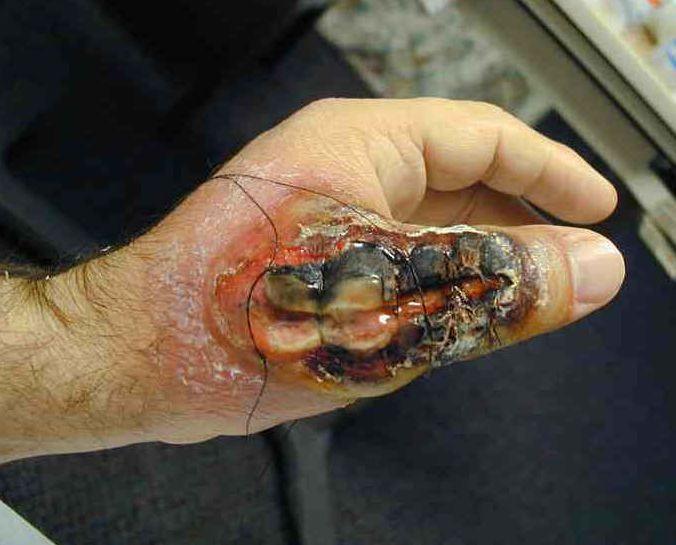
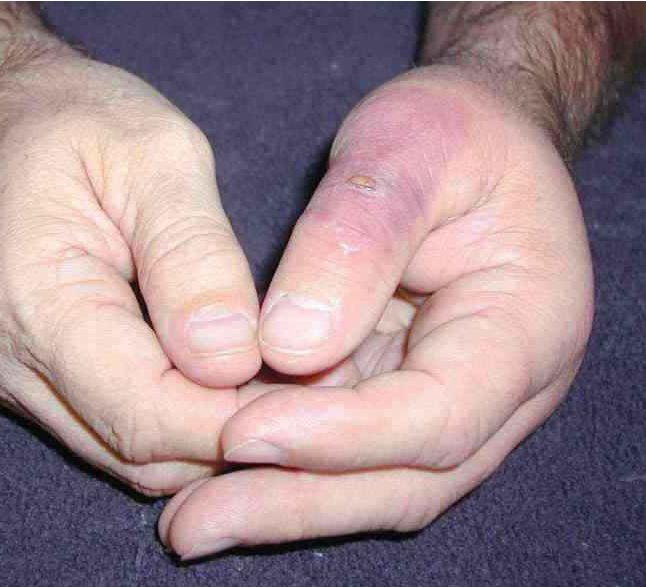
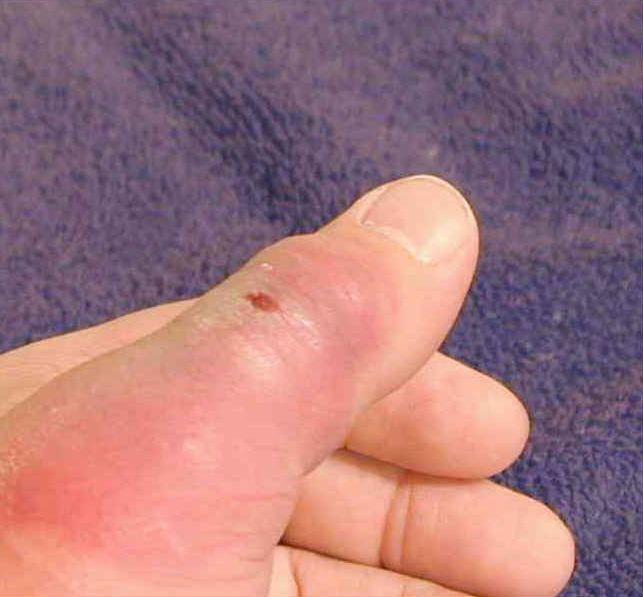
I have those pictures of the Spider bites (the camel spider). I was hesitating to publish them, but your comment encouraged me to do so.


pmusu

Hi from Iraq
thank you for your wishes, the people in Iraq wish you and all the people of the Island of Malta the same.


strykerdad

"TT, has anyone from your group tried to contact anyone connected to the Task force? I am having some trouble understanding how a clinic connected to a large hospital and with funds to spend is unable to obtain such a commonly available medical appliance. Is that true of all similar items?"

I am sure you will have some trouble understanding how the situation is here in Iraq. You believe what you want, and every other thing is just a lie.

Off course no one of my group tried to contact any one connected to the Task force. The reason we don't trust that they are here to help, or at least that is what we feel.
BTW the Oncology hospital is not a large one, it is the smallest hospital in Mosul, there is no funds to spend in any way. When I say "we don't want money because we have enough", I meant by we, the patients and the staff working in the Ostomy Unit.
The lack of Ostomy appliances is a minor thing among the lack of Medicines, mainly the Cytotoxic drugs, and the lack of Narcotic analgesic used to relieve cancer pain.

Most of the Hospital in Mosul are Governmental including the Oncologyand Nuclear Medicine Hospital. That mean they receive their supplies of medicines and medical appliances from the Ministry of Health, not through any organization. Even the items reached the hospital as assistants from other Organizations, they should inform the MOH about them.

"TT seems less than wildly enthused by the offers of help, but as others have pointed out, there may be many different reasons for that apparent lack."

Sure, I am not so excited by the offer of help, because we were disappointed several times before, many promises but nothing happened. In addition, you and all the warmongers consider me/us your enemy, your duty is to kill not to help, the picture of a marine killing a wounded person in Falluja is still in front of my eyes. How a killer can be so humanitarian.
Also my request was to heiko who offer to help by himself.

As a matter of fact, if I have the chance to make a request I probably chose the availability of the medicines, specially the Cytotoxic and the major narcotic analgesic.

Sunday, June 19, 2005

Bad days

Those days are really bad, here in Mosul, there are many accidents of kidnapping, killing and hijacking.

Before a couple of days, a neighbor's son which is 30 years old, married and have 4 children was kidnapped from his shop in the most crowded street in Mosul. Today before noon they found his body with two bullets in his head.

Yesterday, just in front of my clinic, a car hijacked in the middle of the day.
Few hours later a body of two dead guys were found 100 m. From my clinic.

This morning at 6:30 about 50 explosions heard, later we knew they were a mortar bomb against an American base. One mortar bomb fell on the house of my close friend's brother, thanks God no body hurt in the house.

The most striking thing is the car hijacking, it is aimed at a certain car mark (BMW). The stolen cars leave the city toward the north. According to police Officer, more than 70 hijacked car a day. One of the incident the thieves were knocking the door of the house and when they open the door they threatened them with gun, either to die or let the thieves take the car. From their accent, they were probably a Kurds from Sulaimanyia.

There is a big shortage of gasoline those days. The line of cars at the gasoline stations may reach several kilometers. The price of gasoline at the black market is 10 folds its original price.

The electricity is very bad, it comes twice a day for max. Two hours each time, the neighborhood generator is stop working because there is no diesel fuel.

The water supply for domestic use is un sterilized, it is highly contaminated, and unsuitable for human use.

Even the air is polluted from the smoke of the old cars, the diesel machine of the generators, and etc.

This is our condition two years after the iberation/occupation.

Friday, June 03, 2005

Monday, May 30, 2005

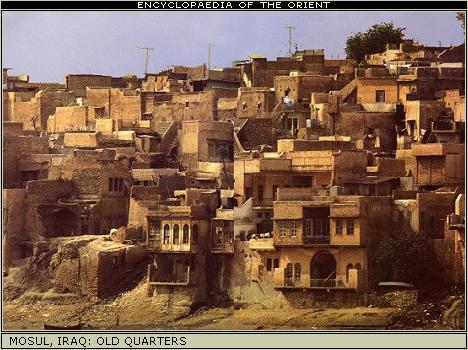
Another old picture of Mosul


I found this picture in the Encyclopedia of the Orient.
It show a side of the city facing the Tigris river. I like this picture because the house in the lower right of the image, the one with two floors, looks like the house where I was born. May be it is the very same house.
At the seasons of flood, the lower floor get filled of water. But at summer, it feels nice and cool.

Wednesday, May 25, 2005

Suicide bombs

There are increasing incidents of explosion every where in Iraq. We usually heard that it was a suicide bomb by a terrorist aiming to kill innocent Iraqis!!!
At the start we used to believe that story. But when think about it logically, we find it unbelievable. Why a person who have a goal to kick the occupiers out of his own country, did hurt his own citizens leaving the occupiers safe.
One of the Iraqi bloggers write some thing worth reading:
"One of the larger blasts was in an area called Ma'moun, which is a middle class area located in west Baghdad. It’s a relatively calm residential area with shops that provide the basics and a bit more. It happened in the morning, as the shops were opening up for their daily business and it occurred right in front of a butchers shop. Immediately after, we heard that a man living in a house in front of the blast site was hauled off by the Americans because it was said that after the bomb went off, he sniped an Iraqi National Guardsman.

I didn’t think much about the story- nothing about it stood out: an explosion and a sniper- hardly an anomaly. The interesting news started circulating a couple of days later. People from the area claim that the man was taken away not because he shot anyone, but because he knew too much about the bomb. Rumor has it that he saw an American patrol passing through the area and pausing at the bomb site minutes before the explosion. Soon after they drove away, the bomb went off and chaos ensued. He ran out of his house screaming to the neighbors and bystanders that the Americans had either planted the bomb or seen the bomb and done nothing about it. He was promptly taken away.

The bombs are mysterious. Some of them explode in the midst of National Guard and near American troops or Iraqi Police and others explode near mosques, churches, and shops or in the middle of sougs. One thing that surprises us about the news reports of these bombs is that they are inevitably linked to suicide bombers. The reality is that some of these bombs are not suicide bombs- they are car bombs that are either being remotely detonated or maybe time bombs. All we know is that the techniques differ and apparently so do the intentions. Some will tell you they are resistance. Some say Chalabi and his thugs are responsible for a number of them. Others blame Iran and the SCIRI militia Badir.

In any case, they are terrifying. If you're close enough, the first sound is a that of an earsplitting blast and the sounds that follow are of a rain of glass, shrapnel and other sharp things. Then the wails begin- the shrill mechanical wails of an occasional ambulance combined with the wail of car alarms from neighboring vehicles… and finally the wail of people trying to sort out their dead and dying from the debris."


This with similar accidents of explosions in areas where it is almost impossible for the resistance to reach and plant their roadside bombs, make one believe in the assumption that there are other hands which did those terrorism for other purposes than to resist the occupation.

Saturday, May 14, 2005

A micro version of Falluja

There is a fight now in another city in Iraq, Al-Qaim situated near the Iraqi-Syrian border. it seems to me that the story of Falluja being repeated again.
"There is a humanitarian crisis in Qaim from the fighting. There are 1,300 displaced families (approximately 80,000 people) from Qaim and the hospital there was destroyed amidst fighting on 8 May between resistance fighters and locals. On the 9th there was no electricity or water in Qaim and the surrounding areas and schools were closed. On the 11th US warplanes continued to bomb Obeidy and other nearby locations."

The complete story can be found here at this URL:

http://dahrjamailiraq.com/weblog/archives/dispatches/000241.php#more

Friday, May 13, 2005

Giant Spider

I found this picture in an Arabic site, for a giant spiders in the Iraqi desert.
I really don't know is it real..? or not.
I have heared a rumer about giant spiders attacking American soldier, but I thought it was just a propaganda. If this picture is real, that means the rumer was correct.

Wednesday, May 11, 2005

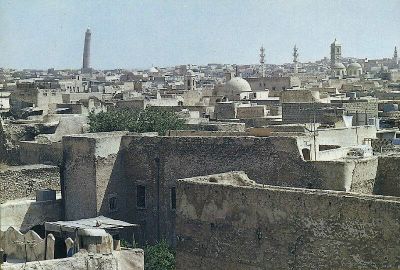
The old city of Mosul

This a picture of the old city of Mosul.
There are two famous structure appeared here, the bowed minaret of the great Mosque in Mosul and the clock's church, together with multiple smallmosques and churches.


This picture has been taken many years ago. The city has been changed alot since then.

Sunday, May 01, 2005

Letting in the Draft?

I found this article by chance, I want you read it, and your opinion about it.

by Tom Engelhardt April 27, 2005


"An overstretched military? You bet. Things going terribly in Iraq? No kidding. Why only yesterday, Jill Carroll and Dan Murphy of the Christian Science Monitor reminded us that, with 140,000 troops (and untold numbers of mercenaries) in Iraq, the Americans can't defend a crucial six-mile stretch of highway between the two lodestars of the American occupation -- Baghdad International Airport, a vast, fortified military encampment, and the Green Zone in the heart of the capital, another vast, fortified encampment. Carroll and Murphy write:

"The danger of the airport road also speaks to the wider problem of securing a country in the face of a dispersed and committed insurgency blended within the civilian population. Millions of cars traverse Baghdad's roads every day, and just a handful of them are carrying suicide bombers. For the Iraqi government and US forces, it's a needle-in-the-haystack problem with few practical solutions. There is limited US military manpower for adding checkpoints, but even if it was logistically possible, stopping every car on Baghdad's roads would bring the city to a grinding halt and make the airport journey even longer than it is now... The airport road is a direct link to the US headquarters in the secured Green Zone. But rather than risk the road, US diplomats fly by helicopter from the airport to the Green Zone."

As Patrick Cockburn of the British Independent commented last week, the inability to stop attacks along this stretch of highway has "become a symbol of the failure of the US in Iraq. Heavily armoured US patrols, prone to open fire unpredictably, are regarded as being as dangerous as the insurgents." On this highway, in the last week, five foreign "contractors" and the young aid worker Marla Ruzicka all died and others were wounded. The Americans undoubtedly dream of bringing in Iraqi troops, sooner rather than later, to help with the security task. Unfortunately, these highly touted, newly trained troops have evidently been deserting their posts in significant numbers in embattled parts of the country. "On the Syrian border, US troops in the Sunni city of Husaybah report mass desertions," writes Oliver Poole of the British Telegraph.

"An Iraqi unit that had once grown to 400 troops now numbers a few dozen who are 'holed up' inside a local phosphate plant. Major John Reed, of the 2nd Marine Regiment, said: 'They will claim that they are ready to come back and fight but there are no more than 30 of them on duty on any given day and they are completely ineffective.'"

In the last months, the Americans (as happened in the latter part of the Vietnam War) have also hunkered down in their bases, attempting to reduce casualties, among other things. In response, the insurgents have recently been launching more sophisticated operations, including, for the first time, serious attacks on isolated bases.

In the meantime, Baghdad continues to be an occupied city -- even at the level of symbolism. A report, translated from the Arabic and appearing at Watching America, an interesting new site featuring pieces about the U.S. from around the world, states:

"Iraq's new president has said he will not reside in the Presidential Palace, which for many Iraqis is a symbol of the country's sovereignty. Jalal Talabani said that the interim government has agreed to rent the palace to the Americans for two years. The presidential complex on the banks of the Tigris River is a maze of palaces, green lawns and orchards... President Talabani said that the Americans 'might' evacuate the palace when the lease expires."

Sovereignty anyone? In order to gain legitimacy, the Iraqis who were elected on January 30th would need to put some real distance between themselves and the American occupiers. However, as Middle Eastern expert Robert Dreyfuss comments in a canny piece at Tompaine.com, "doing so... is impossible, since the newly elected regime wouldn't last a week without the protection of U.S. forces." In any case, the new government, such as it is, will be a familiar one. "[V]irtually all of its leading actors," Dreyfuss comments, "are retreads from the IGC, which was appointed by L. Paul Bremer, and from Ahmed Chalabi's Iraqi National Congress, the exile-dominated coalition that included Chalabi, Talabani, Abdel Aziz Hakim of the Supreme Council for the Islamic Revolution in Iraq, and other officials and members of the just-elected National Assembly."

To the frustration of the Bush administration, the Iraqis have proved incapable for almost two months of forming a government, in part because of the nature of Article 38 of the "interim constitution" that Bush officials so cleverly imposed upon them, as Justin Raimondo, columnist for Antiwar.com pointed out recently. And, of course, they too must meet inside the Green Zone where, Rory Carroll of the Guardian observes, "the 10,000 Iraqis who also live in the zone need passes to enter and must negotiate several checkpoints, as if they are in quarantine." Even the legislators are not immune from the indignities of occupation. As Carroll reports:

"Last week an assembly member named Fattah al-Sheikh said he was roughed up and humiliated by US troops on his way in. One allegedly grabbed him by the throat, another handcuffed him, and a third kicked his car. 'I was dragged to the ground,' he told parliament, weeping. 'What happened to me represents an insult to the whole national assembly that was elected by the Iraqi people. This shows that the democracy we are enjoying is fake.'"

Juan Cole offered the following on this incident: "[It] will seem minor to most Americans and few will see this Reuters photograph [of the legislator wiping away his tears] reprinted from al-Hayat... But such an incident is a serious affront to national honor, and Iraqi male politicians don't often weep." Naturally, Brigadier General Karl Horst of the 3rd infantry division "expressed regret" and promised "a thorough investigation"; but we've just seen, in the case of kidnapped Italian journalist Guiliana Sgrena and Nicola Calipari, the agent who died on the Baghdad Airport road after rescuing her, how such investigations generally turn out -- even when those who have suffered at American hands are citizens of the administration's second closest ally, Italy, with its government in desperate shape and its deployment in Iraq at stake.

This seems to be more or less the state of things -- impunity and quiet desperation -- as the Bush administration tries to keep the world it dreamed of dominating under some kind of control; and yet, as Michael Schwartz has made clear, it faces a daunting task simply keeping boots on the ground in Iraq. By the way, General Eric Shinseki's prewar comments -- which more or less got him laughed out of Washington by the neocons -- that we would need "several hundred thousand troops" to succeed in a post-war, occupied Iraq have often been quoted by critics, who invariably point out how right he was. I've never, however, seen anyone explain where exactly those 200,000-300,000 extra troops were going to come from. What we can now see is that, before the invasion of Iraq ever began, the Pentagon had already traded in those boots-on-the-ground for its high-tech army. (This is why, as the Boston Globe reported recently, ill-prepared Air Force and Navy personnel find themselves assigned to duties like "protecting supply convoys traveling along Iraq's violent roadways" -- and dying.)

It wasn't simply that Rumsfeld was wrong in his decision. After all, to do otherwise than he did, he would have had to strip the empire of troops. I suspect, given the numbers, that he had little choice -- of course, he and his cronies also believed in those strewn flowers and that "cakewalk" -- and that Shinseki's "several hundred thousand" statement was his way of saying exactly what they didn't want to hear: Don't do it, guys! So much for retrospect. As for the future, the Bush administration, backed into a military corner, may turn its thoughts to a future draft."

This is one of many articles about the war in iraq I found in this site.
The name of the site is Iraq Watch
Iraq Watch is a ZNet subsite providing alternative news and analysis of past, present and ongoing events, conflicts and crises in Iraq.

You can find it at "http://www.zmag.org/CrisesCurEvts/Iraq/IraqCrisis.cfm"

Thursday, April 21, 2005

The release of more innocents

Today the April 21, is the birth day of prophet Mohammad(pbuh).
All the Muslims people in Mosul are celebrating this anniversary.
There were a big official celebration in the governorate of Nineveh, transported by the Iraqi media (Al Iraqia; TV Nineveh).

The governor of Nineveh announced in his speak, in this occasion, the release of 110 prisoners who were arrested for suspicion of being terrorists and found to be innocents later on.

For the first time in Iraq (I guess) a responsible authority in Iraq apologize frankly in a publics and in front of the TV lens, to the prisoners, telling them they are arrested by mistake. And this mistake can happened in a circumstances like this.
He asked them to cooperate with the policemen in controlling the peace in the city!

This speaks received acceptance from all the audiences.

Saturday, April 09, 2005

Some answers to some questions (comments).

ahmad

anonymous @ 4/8/2005 08:52:24 PM had answered you.
________________________________________

anonymous @ 4/9/2005 01:39:08 AM

The UNICEF report you linked to, say
"Unexpectedly perhaps, the rural-urban division evaporates when it comes to malnutrition, with children no more malnourished in the countryside than in the towns and cities. Ready access to locally produced food and higher incidence of breastfeeding provide at least some protection for rural children who, according to the survey, lag behind in so many other areas."
And if remember what I have been said
"The amount of these foods sections are insufficient for ordinary person, but it supported the poor families, and it did prevent malnutrition in Iraq to an acceptable level."
The report above spoken about specific area ( The governorate of Mesan) in southern and central Iraq.
"So you're basically saying malnutrition was not a major problem during the "sanctions" period of 1991-2003?"
It is definitely a problem, specially when added to lack of other food stuffs not involved in the program of (oil-for-food and drugs), the lack for drugs, for sanitation specially in the rural areas, and other goods necessary for ordinary living.
That report also says:
"The MICS also reveals serious problems in rural areas, where only half the people have access to a water supply from a network, public tap or well, compared to 96 per cent of people living in towns and cities. Only 34 per cent have a sanitary type of latrine, compared to 97 per cent of the urban population. Immunization rates are some 10 to 15 per cent lower in rural areas and the survey found similar gaps in the proportion of rural children who have received Vitamin A supplements and on the numbers entering primary school."
But the level of vaccination was satisfactory:
"The Multiple Indicator Cluster Survey does reveal some positive, as well as negative, trends. About half of all children surveyed had received at least one dose of Vitamin A, and immunization coverage remains adequate, with at least 80 per cent of children aged one to two years immunized against measles. The survey reveals no significant gender disparities between boys and girls in any of the areas examined. "
Thank you for the link to this report anon.
_______________________________

John

Thank you for supporting the TRUTH.
__________________________

Waldschrat

"You mention security as a problem. Did security in Mosul become worse after Falluja? "
Yes, it become worse, I guess, there were two reason for that;
First, the people here are very compassionate with the people of Falluja.
Second, some of the fighter of Falluja were escaped to Mosul after that massacre.
"Is is there any real improvement in security in Mosul recently? Are Iraqis in Mosul becoming more safe or less safe? And do you see any benefit to security from recent meetings of the elected assembly? Is the political situation becoming more acceptable or less acceptable to most people in Mosul?"
Yes there is a clear improvement in security during the last weeks, but from yesterday and this morning there are a lot of explosions and shots in our neighborhood. There was an explosion of bombed car less than 100 m from our house, thanks God we were out of the house at that time. We don't know the exact situation right now.
It too early to see any benefit to security from the elected assembly.
The political situation to the neutral Mosul citizen at present is described as ( wait and see).
We heard a promises and want to see the realities.
_______________________________

maddog

"Truth Teller, tell me the meaning of your words "the situation of vaccination in Iraq. It was perfect before the war." Do you really know of what you speak? That goes completely against what the world now knows and understands."
Read the above answers, I think it will satisfy your inquiry. The rest of your questions were answered by John, I think.
____________________

Anon. @
4/9/2005 09:39:58 AM


"Are you suggesting that your country was better off under the rule of Saddam? "
It is not fair to compare the condition right now with that under the rule of Saddam!!
The fair comparison should be made after the situation settled down.
Anyhow looking to the situation from every side. It was better under the rule of Saddam. I don't mean Saddam was a good guy, but he controlled the whole things in a secure way.
What concern the people now, is the security, which was much better at that time.

"But in my opinion if your country is so much worse now maybe they should free Saddam and let him get it back to the good life you all enjoyed!"
I will not comment on this phrase. Ask your government. Who asked for the occupation.
But when things happened, and hundred of thousands killed, all for mistake or a misunderstanding of CIA reports, or they were fooled about the WMDs because of "double agents, we prefer to have REAL democracy than the rule of a dictator. But the price we are paying is very expensive.
_________________________________________________

anon.@ 4/9/2005 10:04:54 AM

"I don't believe in the statements by Bush saying we are in Iraq to bring "freedom and democracy" any more than I believed the "Saddam has WMDs and is a threat to the USA" crap.

According to what Perle said the other day to the US Senate, they were fooled about the WMDs because of "double agents".... which means double agents are influencing and directing our federal government!

And no appologies from any damn one of them... to Americans or Iraqis! They don't give a rip who dies, as long as they make a bunch of money."
You said all what I have to say. But in better English than mine. Thank you.
Friday, April 08, 2005

Some pictures from Falloja

Those are some pictures taken in Falloja city after the war there, they showed the amount of damage to some buildings in the city, mainly schools.
The students returned to school to complate their study.The sources from where I got these pictures are:
Electonic Iraq
Electronic Iraq 2


May be those are enough evidences about what the people of Falloja suffered.

Tuesday, March 29, 2005

Fallujah Story-- Must Read

I received this e-mail today from a friend . He forwarded it from Mark Manning, a California documentary film maker who was recently in Fallujah to talk with some of the Iraqis who managed to live through the U.S. "clean-up" (read "flattening") of that city

Read it and weep--literally.


Note to moderators-- this is an e-mail that is intended to be spread around.

Dear Friends,

I have been out of touch. I have been in Iraq and would like to
share a little of my story with you today.

I got back from Iraq a few weeks ago where I stayed inside the city of Falluja and lived with the refugees of that city for over two weeks. I decided to go there because it seems to be the heart of the trouble in Iraq and the place to see if any sense or peace can be found. I had also heard that the city had 250,000 citizens in it who
were told to leave when my government attacked, yet there had been no stories of their situation in our media. As an American, I felt responsible for this and decided to take a look myself.

On February 10th 2005 I flew into Iraq and drove to the city of Falluja. For over two weeks I was a resident and a refugee of Falluja and I am honored and privileged for that experience. They hosted me in their homes, and cared for me because they believed that I was there to listen to them and to honestly bring home their stories to the American people. I came to Falluja without military escort or armed protection in any way. I think because of this they thought I was crazy, but they honored what they thought was courage and they trusted me. Trust means everything there and they look deep into your eyes as they decide who you are. I lived with them and listened to their stories. They told me they do not trust American journalists to accurately tell the story of Iraq. They believe that the American public does not know what is really happening there, and that if they did they would feel differently about the war. They feel that the American people are their brothers and sisters and they are asking them for help. They wanted me to tell you their story.

The horrors of war have been brought to the people of Falluja. The people there say the city had 500,000 people in it, not the 250,000 quoted by our media. The refugees told me that they were given one week notice to leave the city. After three days, they were told they could no longer drive out, they had to walk. No camps were established for them and no refugee location was given. There was no planning by the American government for the people, no food, no shelter and no water. They were just told to leave or be killed. Anyone who stayed in the city after one week would be considered a terrorist and would be killed.

For five months these people have been living in any location they could find, nothing was established for them in the surrounding areas of the Falluja countryside. They are living in tents in the mud, schools, abandoned chicken coups, burned out buildings, cars and other buildings that people were not using or where others have
made room for them. The weather is bad, with much rain and it is very cold. When they were told to leave the city, it was summer and they were not dressed for this cold and many could not carry out their clothes. Some lucky children are going to school in tents and all the classes have been shortened to 2 hours per day. Food is
short and they are eating what the farmers grow and the surrounding community can spare. Again, even after five months they have received no outside aid from either the American government or the new Iraqi government.

The city itself has been devastated. Most houses have been seriously damaged, with about 65% of them totally destroyed. Evidence of depleted uranium (DU) shells is everywhere. This leaves radioactive contamination behind which has a half-life of 4.5 billion years. (See note1). Unexploded ordinance is a common sight. Many residents who were there speak of chemical weapons, napalm, cluster bombs and
phosphorous used by the Americans. These are all illegal weapons and considered war crimes by the international community. Many of the houses were fired, meaning that the troops burned them down after searching them. Many houses with white flags and markings stating "Family Here" were destroyed.

Some families who had nowhere to go stayed in the city during the fighting and have paid dearly. I interviewed many people who were there and their stories will live forever in my mind. Here are some samples:

· A mother whose son was killed by DU shells. He was in his bed sleeping when the shells came through the walls.

· A father who at 65 years of age was shot during a raid of his house, whose son was arrested during that raid and has not been seen since (he states that his son was not a fighter.)

· A 17 year old girl who hid under her bed with her 13 year old brother during a raid of her house and witnessed her father, her cousin, and her two sisters 18 and 19 years old, all shot to death.
She hid for three more days with the dead bodies of her family and then they returned and shot her and her brother after finding them under the bed. Her brother died. She survived and told me her story.

· A Family of ten who lived through all the fighting. The kids were 3, 4, 5, 7, 8, 10 and 12. They were a mess. These kids will never be ok. Their faces were marked with open and oozing sores and they were exhibiting serious signs of emotional damage.

There is presently very little medical aid available to the residents and refugees, and again, no aid has been provided to the refugees in the surrounding area. The medical centers in the city have been destroyed and have not been rebuilt. The main hospital has been reopened, but to get there you have to walk, as the ambulances are still being shot by the Americans and the Iraqi National Guard. The doctors have been beaten and their lives have been threatened by the Iraqi National Guard. These are the security forces that the Americans are training. The new government has warned them not to talk to any journalists about the conditions in Falluja. They
understand this threat to be very real and a direct threat on their lives and the lives of their families.

To walk to the hospital you must go through checkpoints, sometimes through fighting, and only at certain daylight hours. The checkpoints are manned by the Iraqi National Guards and they are very hostile to the residents of Falluja. When we were at the hospital, an old man died of a heart attack because he was not allowed through the checkpoint. A woman gave birth in the ambulance because they would not let the ambulance back to the hospital after 5 pm and instead turned it away with her in labor.

We delivered by hand the medical aid provided by some of you to the hospital in Falluja. Me and one Iraqi woman, WE were the international medical aid to Falluja. We carried these boxes one at a time through the checkpoints, across the bridge and into the hospital. They would not let us drive in, we had to walk these boxes in. We did it every day for a week, one box at a time.

All of the people I talked to had messages to the American people.
They said: "We did not attack you! We have done nothing to the Americans. Why have you done this to us?"


These are the people who hosted me, fed me, and worried about my safety. They took care of me and I will never forget their generosity, compassion and grace. They want peace with America and they want the fighting to stop. They feel they are the ones being attacked and that the Americans are the terrorists. They see absolutely no justification for this war and were constantly asking me to explain how the American people can support these acts against a civilian population. For the first time in my life, I was ashamed to be an American.

There are so many more stories to tell you and I will be making a film about it all. But for now, what I want you to know is that I spent two weeks in the heart of the beast. The place where our government and media said is the heart of the resistance, terrorists and Saddam Loyalists, and guess what; the place is full of people. People like you and me. Kids are everywhere. The average Fallujan family has 10 people in it. That means about 8 kids. 500,000 people in the city, you do the math. That is a lot of kids.

There are fighters in Falluja. That is a fact. But they are surrounded by some 490,000 innocent people. As a country, we have decided the damage to the innocents is worth the end result, whatever that may be. These people are being shattered by this very serious situation that they have no control over. They are the
innocent victims of this war.


I cannot tell you what to do. This is a story of just one area in Iraq. These stories are all over the area we call the Sunni Triangle. But I was there and lived with these people and they taught me about love, forgiveness, truth and compassion. They, after all that has happened to them, still have the ability to differentiate between the acts of an enemy and the people of a nation. They cry out to us to save them from the ignorance that has brought this destruction on them. They have suffered 33 times 9/11. Over 100, 000 Iraqis have died at the hands of the American invasion (note 2) and still they say that they have nothing against the American people. This is grace. I learned from these people how to find peace. By deeply listening to my "enemy" I have found that the real enemy is ignorance and fear and acting from that place ofweakness.

I will never forget the people of Falluja.

Thank you for listening to them.
Your Friend,

Mark Manning


I want you all read it, and think about it in neutral way.

There are more details from the same source here.

Thank you for your time

Thursday, March 24, 2005


My Grandfather
This is a picture of a portrait of my grandfather in traditional arabic clothes, painted by the famous mosul's painter " Najeeb younis".

Wednesday, March 23, 2005

Fight for minds uses a TV show as battleground

I copied this article from a site in the internet, it contained more details about the confessions of the prisoners I already mentioned in my previous posts.
The title of the article is:

Confessions rivet Iraqis

Fight for minds uses a TV show as battleground

By Thanassis Cambanis, Globe Staff | March 18, 2005

BAGHDAD -- Iraq's wildly popular new television hit features a nightly parade of men, most with bruised faces, confessing to all kinds of terrorist and criminal acts.

''Terrorism in the Hands of Justice" is the Iraqi government's slick new propaganda tool; its televised confessions, police say, aim to discredit the armed resistance and advertise the government's success at cracking down on gangs.

If it is meant to showcase a brave new Iraq, the television show is starkly reminiscent of the bad, old Iraq. Part ''Oprah Winfrey Show" and part ''Cops" -- with a strong flavor of Saddam Hussein-era strong-arming -- the show airs six nights a week on the state-run Iraqiya network.

Since its debut a month ago, ''Terrorism" has become a fixture in Iraq's cafes and living rooms. Iraqi government officials brag that the show has ruined the image of jihad, or holy war, in the country, exposing the resistance as a racket of street criminals and thugs who attack Americans and Iraqi security forces for pay.
It also raises a host of questions about Iraq's treatment of the suspects and the reliability of their confessions.

The bruised, swollen faces and hunched shoulders of many of the suspects suggest they have been beaten or tortured. The neat confessions of terrorist attacks at times fit together so seamlessly as to seem implausible. And the suspects are presented to the public without any legal process to protect them, presumed guilty, with no word about rule of law as a weapon in the arsenal against terrorism. US officials have sidestepped questions about the program airing on Iraqiya, a network still run by an American contractor hired by US occupation officials nearly a year ago.

There is no question, however, about the program's popularity and wide reach. Men at cafes debate the details of certain gang members from ''Terrorism." Others interrupt soliloquies about recently murdered relatives to declare: ''I expect to see his killers on TV." The show aims to change the minds of Iraqis who see insurgents as noble, patriotic Muslims.

Powerful politicians have blasted the show: Mohsen Abdul Hamid, head of the Iraqi Islamic Party, a Sunni party that gets support from Arab nationalists, tribes, and the insurgency, called a press conference recently to accuse the show of airing lies, outraged not that a party member was presented as a terrorist, but that the man confessed that he drinks alcohol and does not pray.

Footage is provided by the Interior Ministry and edited by state-owned Iraqiya. After the US invasion, the Coalition Provisional Authority restarted the state-owned Iraqi television network as the Iraqi Media Network and renamed the main state channel ''Iraqiya."

Colonel Adnan Abdurahman, the Iraqi police official in charge of producing taped confessions for the show, dispatches a camera crew wherever police commandos make a lot of arrests. In the last week, his staff has filmed confessions in Mosul, Baqubah, and Baghdad

''Previously Iraqi people saw the resistance as fighting the occupation," Abdurahman said. ''But when people saw how they talk, and the details of their actions, they became despicable in the eyes of Iraqi society. They're not resistance. None of them say they are fighting Americans. They are killing Iraqi National Guard and Iraqi police, only Iraqis."

In the show's opening montage, the theme song from ''1492: Conquest of Paradise" by Vangelis plays over images of hooded members of Tawhid and Jihad about to execute an American hostage in an orange jumpsuit, a bloodied corpse, and finally two smiling Iraqi children holding paper signs that say ''No to Terrorism."
Then a police special forces trooper in camouflage uniform and a red beret extols the work of ''our brave, noble Iraqi law enforcement brothers."

Who are the perpetrators of the daily bombings and ambushes that have killed hundreds of civilians, Iraqi police, and soldiers?
According to the taped confessions, the answer is, essentially: lowlifes.

The fighters almost never describe themselves as patriots or holy warriors; they say they fight for pay. Many of the men admit to homosexual acts, considered particularly shameful in Iraqi culture. They frequently admit to rape and pedophilia, and clips often end with the unseen interrogator excoriating the detainee for having no honor.

On a recent episode, alleged members of an insurgent cell from Mahmoudiya -- a town south of Baghdad in the dangerous ''Triangle of Death" --admitted to murdering and raping several Iraqis.

A man who identified himself as Azawi Hassan Azawi said the leader of a criminal cell induced him to kidnap and kill a young boy by offering Azawi his sister in marriage.

Another man, identified as Hassan Mahdi Hassan al-Kafaji, said he used to fight in the Saddam Fedayeen militia. After the war he joined Tawhid and Jihad, the jihad group led by Jordanian terrorist Abu Musab al-Zarqawi, as a killer for hire; he said he pops pills before each mission. ''They pay me $100 or $150 for each person I slay," Kafaji said

Talal Ra'ad Ismail al-Abassi came next; he said he led an insurgent cell in Mosul.
According to the interrogator, Abassi had been imam of a mosque but was fired by religious authorities under Hussein for having sex with men inside his mosque.
Abassi said his group had killed a dozen Iraqi ''collaborators" -- once a leader can claim 10 kills, he becomes an ''emir," or prince -- to earn $1,500 a month from Saudi financiers of the insurgency. ''I do not believe in jihad in Iraq," Abassi told the camera. ''It was important for my group to kill enough people that I could become an emir and get the $1,500 salary."

On another episode, a group of men from Samarra took responsibility for a series of strikes that killed Iraqi police and interpreters for US forces. In quick succession, the men detailed how they were paid less than $200 to kill and mutilate five Kurdish peshmerga fighters.

Qahtan Khalid, the last man to appear before the camera, was skinny and hunched over, his face more bruised and sunken than the rest. He said he was a policeman who had collaborated with insurgents in 10 killings. ''I joined them so they would not slaughter me," he said.
Yesterday Khalid's father told the Agence France-Presse wire service that Interior Ministry police commandos delivered his son's corpse to him.
The Iraqi Human Rights Ministry has opened an investigation.

US and Iraqi officials said that airing confessions on television is completely legal.

The 2004 State Department's Human Rights report, which was released two weeks ago, noted that hundreds of cases of alleged torture are pending against the Iraqi government. ''Reportedly, coerced confessions and interrogation continued to be the favored method of investigation by police," the report said.

Mishan Jabouri, a Sunni tribal politician elected to the new national assembly on Jan. 31, said he had evidence that the confessions are bogus.
A constituent from Mosul wrote Jabouri last week to say that his brother appeared on the show on Feb. 22, and confessed to killing four men. But the names of the victims he listed were all relatives who are still living.
''All these deceased are alive and not dead. They are ready to stand in front of your excellency," Muthana Abdullah Khalil wrote. ''I don't know the reason that led my brother to these untrue confessions, but we are ready to bring the living dead in front of you to prove our allegations."

Abdurahman, the police colonel who provides the confession footage, dismisses such accusations. The judicial system will punish any police who torture suspects or elicit false confessions, he said, impatiently brushing aside questions about the treatment of detainees.
''Our work is being appreciated. That's the biggest objective," he said. ''People are demanding that the cruelest punishment be inflicted on those shown on TV."